The Most Common Material Question We Hear in Beverly Hills
Every week, homeowners across Beverly Hills, Bel Air, and West Hollywood ask us the same question before starting a hardscape project: Should I go with travertine or concrete pavers? It's a great question, and the honest answer is that both materials can produce stunning results — the right choice depends on your specific application, budget, aesthetic goals, and how the space will be used.
At Richard & Sons Beverly Hills Pavers Installers, we've installed both materials on hundreds of projects throughout the greater Beverly Hills area. Here's what we've learned from years of hands-on experience.
What Is Travertine?
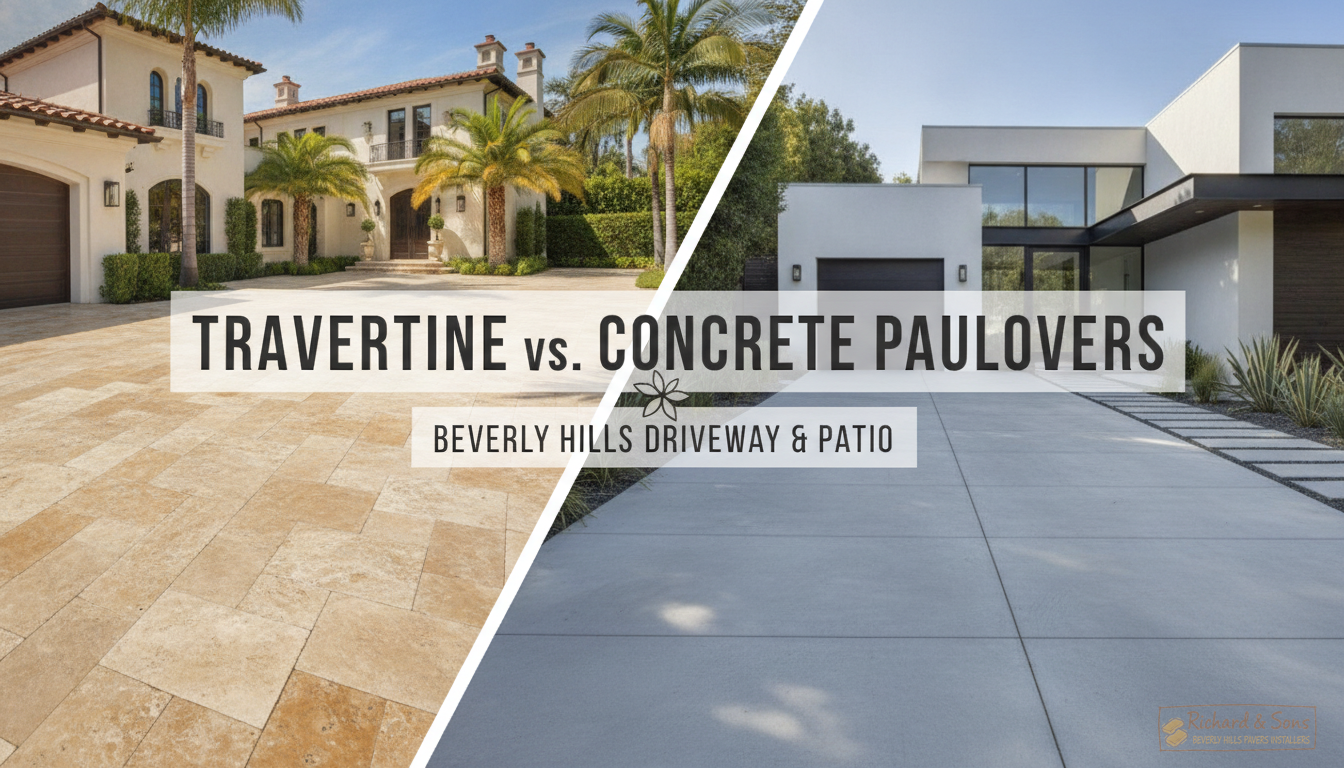
Travertine is a natural limestone formed by mineral-rich spring water deposits. It's quarried primarily in Italy, Turkey, and Peru, and it has been used in architecture for thousands of years. The material's characteristic cream, ivory, and warm beige tones are a natural fit for the Mediterranean and Spanish Colonial architecture that dominates much of Beverly Hills and the surrounding neighborhoods.
Travertine pavers come in two primary surface finishes:
- Tumbled: Edges and surfaces are softened for a rustic, aged appearance that blends naturally into garden settings.
- Honed or filled: A smoother, more contemporary surface that suits modern architecture and minimalist design.
One of travertine's most celebrated properties in Southern California is its thermal performance. The light-colored stone reflects solar radiation rather than absorbing it, which means travertine pool decks and patios stay significantly cooler underfoot than dark concrete or brick on a hot July afternoon. This makes it a top choice for our pool deck paver installation projects throughout Beverly Hills.
What Are Concrete Pavers?
Concrete pavers are manufactured from a high-strength concrete mix that is pressure-formed into precise dimensions and cured to produce units that are typically stronger in compression than poured concrete slabs. Modern concrete pavers come in an enormous range of sizes, profiles, and finish textures — including finishes that convincingly replicate the look of natural stone, cobblestone, and even wood grain.
For driveway paver installation, concrete pavers are particularly popular because they are engineered to handle heavy vehicle loads, are available in large-format designs that suit contemporary homes, and can be sourced in a consistent color that won't vary from pallet to pallet the way natural stone sometimes does.
Side-by-Side Comparison: Travertine vs. Concrete Pavers
Aesthetics
Travertine wins on natural character. Each piece is slightly unique, with natural veining and tonal variation that gives a finished installation an unmistakably high-end, organic feel. Concrete pavers offer more design consistency and a far wider range of manufactured profiles — if you want a very specific contemporary look with precise lines and repeating geometry, concrete pavers may give you more control over the final result.
Heat Performance
As noted above, travertine performs exceptionally well in the Beverly Hills heat. Light-toned concrete pavers also reflect heat reasonably well, but darker concrete paver options can become quite hot in direct afternoon sun. If you're planning a barefoot-friendly pool deck, travertine is almost always the more comfortable choice. Visit our pool deck paver installation page to see how we engineer drainage and coping integration for poolside projects.
Durability and Maintenance
High-quality concrete pavers typically test at 8,000 PSI or higher in compressive strength — extremely durable under both vehicle traffic and foot traffic. Travertine is softer than granite but still highly durable for residential applications. Both materials benefit from periodic sealing, though travertine's natural pores mean it should be sealed before use and resealed every few years to prevent staining.
Cost
Travertine is generally more expensive per square foot due to quarrying, international shipping, and the natural material premium. Concrete pavers can be more cost-effective, especially for very large projects like full driveway replacements. That said, in the Beverly Hills luxury market, travertine's premium price is often viewed as an investment rather than a cost — it consistently signals quality to buyers and appraisers.
Best Applications for Each Material
- Travertine: Pool decks, front entry walkways, Mediterranean-style patios, and high-visibility areas where natural elegance is the goal.
- Concrete pavers: Driveways, large contemporary patios, areas with heavy vehicle traffic, and projects where design consistency and manufactured precision are priorities.
Many of our most beautiful Beverly Hills projects actually combine both materials — for example, a concrete paver driveway that transitions into a travertine pool deck through a tumbled-stone garden pathway. This layered approach creates visual interest while using each material where it performs best. See our walkway and pathway paver installation service to learn how we create seamless transitions between hardscape zones.
Let Us Help You Choose the Right Material for Your Project
Whether you're in Bel Air,
Questions about pavers in Beverly Hills, CA? We're happy to help — no sales pressure. Call +14244333799 or fill out our online form for a free, no-obligation quote.Talk to a Local Pro